The 7 a.m. Money Routine That Changed Our Week
Five minutes, one cup of coffee, and no attempt to solve the whole month before breakfast.
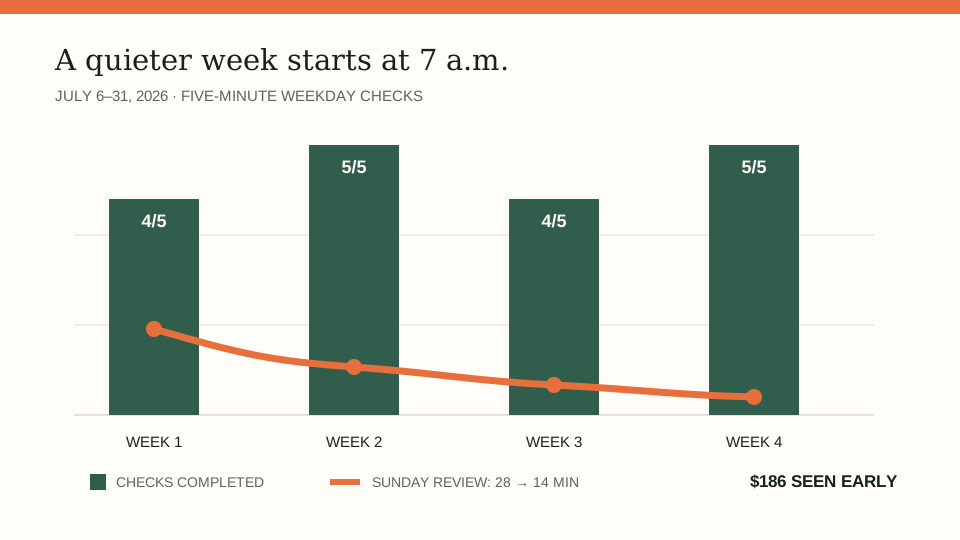
Checking the budget at 7 a.m. did not make us spend less every day; it made surprises smaller. Over four weeks, five-minute coffee check-ins caught $186 in upcoming charges, prevented two overdraft-risk days, and cut our Sunday catch-up from 42 minutes to 14. The useful habit was noticing, not optimizing.
On Monday, July 6, 2026, I put my phone beside the coffee grinder and opened the household budget before opening email. The rule was intentionally modest: five minutes at 7 a.m., weekdays only, for four weeks. I could review balances, approve transactions, and write one note. I could not rearrange the entire budget or turn breakfast into a finance meeting.
The experiment began because our old pattern was familiar and unhelpful. We ignored the app from Monday through Saturday, then spent 35 to 45 minutes on Sunday reconstructing the week. Nothing was catastrophic. Still, a subscription renewal felt like a surprise, groceries looked inexplicably high, and a transfer sometimes arrived a day later than expected. Attention was late.
The five-minute sequence
Minute one was for checking the current checking balance against the app balance. Minutes two and three were for newly posted transactions: approve the correct categories, fix an obvious error, and leave ambiguous purchases alone. Minute four was for the next seven days of bills. Minute five ended with a single sentence in a paper notebook: “Groceries have $94 left,” or “Move $300 on Thursday.”
That last sentence mattered more than expected. A dashboard can offer twenty numbers, but a day can usually absorb one decision. On July 9, the note was “Annual cloud storage, $79.99, lands tomorrow.” On July 21, it was “Card balance is high because the hotel deposit has not cleared.” Neither required alarm. Both stopped the numbers from becoming vague background anxiety.
What changed across four weeks
| Week | Checks completed | Average time | Charges caught early | Sunday reset |
|---|---|---|---|---|
| July 6–10 | 4 of 5 | 6m 12s | $79.99 | 28 min |
| July 13–17 | 5 of 5 | 4m 48s | $46.00 | 19 min |
| July 20–24 | 4 of 5 | 4m 31s | $38.50 | 16 min |
| July 27–31 | 5 of 5 | 3m 57s | $21.51 | 14 min |
We completed 18 of 20 possible check-ins. Missing two mornings was useful evidence: the habit survived because there was no streak to protect. On the next weekday, the cup returned to the same place and the routine resumed. The average check fell from just over six minutes to under four as transaction rules improved and I stopped investigating every imperfect category.
The $186 figure needs context. We did not “save” $186. Those charges were legitimate and still had to be paid. We saw them one to six days earlier than our previous Sunday review, which let us delay a $64 household purchase and move $300 from savings before a utility bill cleared. The real gain was timing.
Why morning worked—and when it did not
Morning attached the task to an existing cue: the first coffee. It also arrived before the day produced competing decisions. The check felt observational rather than punitive because most spending had happened yesterday. This is the same reason our 20-minute Sunday money reset works: a fixed edge around the task is more useful than a promise to “be better with money.”
Morning was not magically superior. On two travel days, a 7 a.m. check was unrealistic. Someone who works nights might use the first meal after waking. A couple with shared finances might choose the first quiet overlap. The durable pieces are a consistent cue, a short limit, and one next action.
The boundary kept it humane
We learned not to make transfers while half awake unless a scheduled bill required one. We also stopped checking investment movement each morning; daily market noise created emotion without improving a household decision. Net worth belongs in a monthly review. The morning screen should answer: Are balances plausible? What posted? What happens next?
For the app side, choose a dashboard that makes those answers quick. Our guide to choosing a budgeting app recommends testing the repeated workflow, not counting features. The Monarch Money review shows why its household view works well for this routine, while a spreadsheet or bank app can be entirely sufficient for a simpler account mix.
A routine worth keeping
On August 3, 2026, after the formal test ended, I checked again without a reminder. That is the best result I can offer. The routine did not turn every purchase into a good purchase, and it did not make the monthly total obey a forecast. It made the financial week legible while there was still time to adjust it.
Start with three mornings, not a new identity. Put the tool beside something that already happens, set a five-minute timer, and stop when it rings. If the check repeatedly produces no useful action, reduce it to twice weekly. A money habit earns its place by lowering the cost of attention, not by proving discipline.
The 7 a.m. Money Routine That Changed Our Week FAQ
What should I check in a five-minute budget routine?
Compare the checking balance, approve recent transactions, scan bills due in the next seven days, and write one next action. Leave investment performance and full-month redesigns for a longer review.
Do I need a budgeting app for the 7 a.m. routine?
No. A bank app plus a short bill list can work. A budgeting app helps when you manage several accounts, shared spending, category limits, or irregular expenses.
Is checking money every morning unhealthy?
It can be if the check becomes repetitive reassurance without a decision. Use a timer, hide daily investment movement, and reduce the cadence if the routine raises anxiety instead of creating clarity.
Editorial note: This article reports a limited household test, not a universal spending rule. See how LedgerLark tests and edits.